Data & Analytics
Cloud-native and AI enabled platform for data and operations.
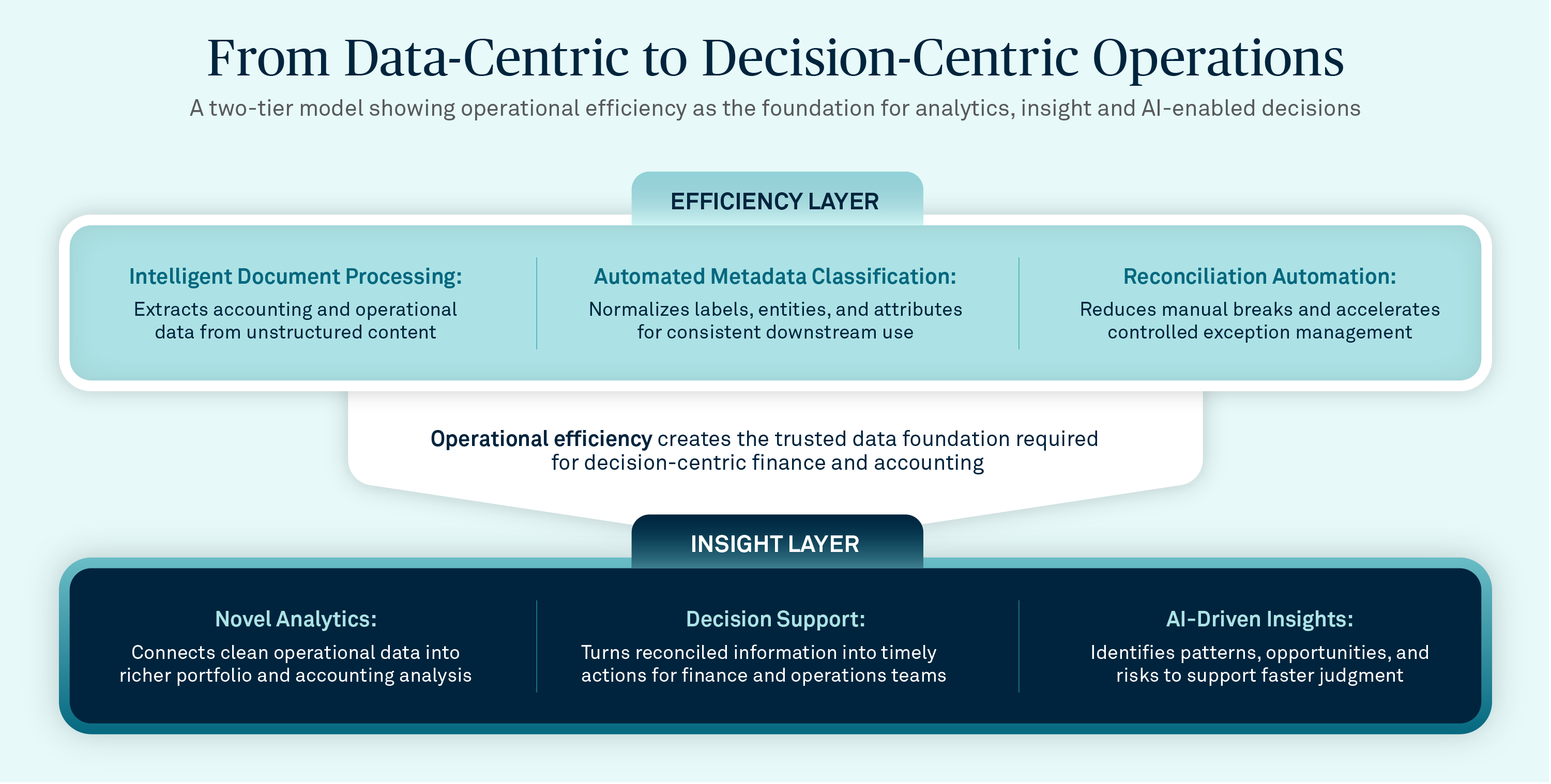
With unprecedented growth of private markets in recent years, the need to unify investment data to achieve a total portfolio view across public and private holdings has become paramount for heads of investment operations at asset managers and asset owners. Chief operating officers are rearchitecting their accounting foundation to build a data-centric strategic decision layer able to be leveraged by AI and convert accounting insights into competitive advantage.
Nearly 70% of asset managers cite data quality as the primary barrier to AI adoption, making achieving a unified ledger the critical enabler of AI insights.1 Additionally, the challenges firms must address regarding opaque and unstructured private markets reporting data, fragmented accounting systems and expanding global regulations continue to strain traditional investment workflows designed for liquid, publicly traded instruments.
The barriers are well known: entrenched organizational silos that resist data sharing across teams; technical debt from legacy systems that were never designed for real-time, multi-asset accounting; leadership misalignment on investment priorities and cultural resistance to change that keep firms anchored to familiar processes.
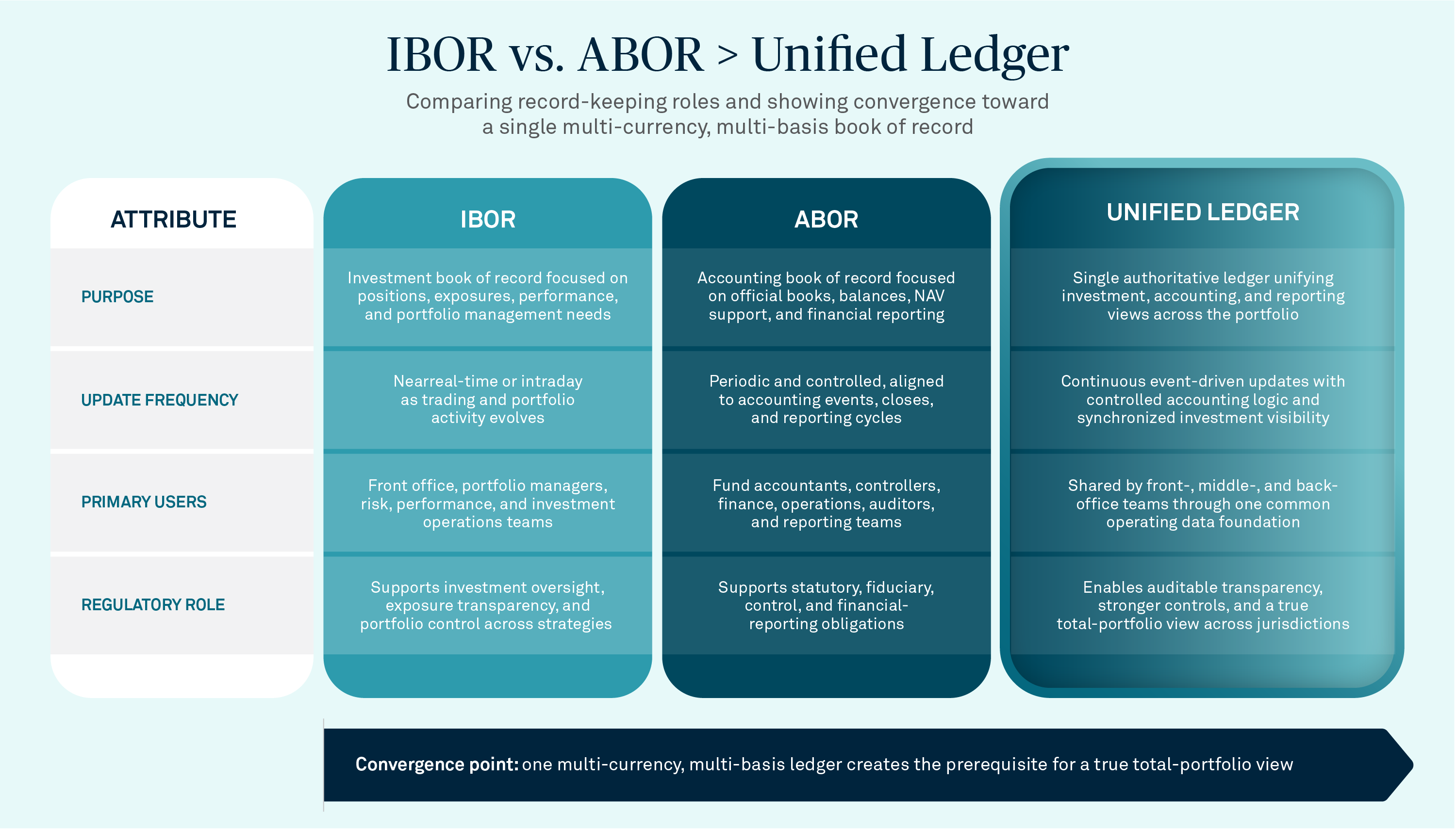
Why a single multicurrency, multibasis ledger matters
Firms operating siloed investment book of record (IBOR) and accounting book of record (ABOR) systems are trapped managing reconciliation overhead and data gaps that lead to delayed decision-making. Unifying books of record on a single multicurrency, multi-basis ledger is the prerequisite for a true total portfolio view and real-time decision-making, because it eliminates the reconciliation lag between what the front office sees and what the official books record. The unification is a technical consolidation that creates the foundation making downstream capabilities such as multi-basis reporting, AI-driven insights and regulatory readiness possible.
Tracking the LP lifecycle
As private market holdings grow, firms are also grappling with tracking LP lifecycle events — commitments, capital calls, distributions — in the same system as public markets accounting, creating fragmented total portfolio views and manual workarounds. The solution is to integrate limited partnership lifecycle accounting into the same ledger as public-markets accounting, tracking initial commitment, funded and unfunded commitments, capital calls and distributions as first-class data objects on a unified platform. This integration approach can help decrease the amount of manual reconciliation between private and public holdings while also providing operations leaders with a single, authoritative view of committed and funded capital across the entire portfolio.
GAAP, IFRS, statutory and tax in one transaction
The expanding and varied global regulatory landscape for private markets presents another common challenge for firms. Requirements such as the Alternative Investment Fund Managers Directive (AIFMD II) and Annex IV reporting in the European Union, the Securities and Exchange Commission’s (SEC) Form PF reporting in the United States, Financial Conduct Authority (FCA) reporting requirements in the United Kingdom and Monetary Authority of Singapore (MAS) requirements in Singapore create complex and often overlapping data demands across jurisdictions.
Meeting these requirements can require firms to aggregate information across portfolio, investor, risk and fund accounting systems. Maintaining separate data sets and reporting processes across regulatory regimes can also increase duplication, inconsistency and operational and audit risk.
The solution: a single transaction that can support Generally Accepted Accounting Principles (GAAP), International Financial Reporting Standards (IFRS), statutory and tax bases simultaneously on one ledger. Each transaction would theoretically be tagged once at the source, and the platform would generate reports across all required bases without duplication or reconciliation between parallel ledgers while allowing for alternate accounting treatment and valuation. This approach potentially reduces regulatory risk, maintains consistency across filings and transforms compliance from a reactive, labor-intensive process into a byproduct of a well-architected accounting foundation.
Intelligent document processing for private markets data
Once the fragmented data silos have been addressed in the accounting foundation, optical recognition technology can be utilized to extract structured data from the unstructured PDFs that private markets investors receive from general partners. Automated metadata classification further streamlines document ingestion. These capabilities directly address the data-quality barrier most asset managers identify as their primary obstacle to AI adoption. The unified accounting ledger is the critical enabler, because AI insights are only as reliable as the data foundation beneath them.
Regulatory and market-structure changes are increasing data and operational demands. AIFMD II requirements are now being implemented across the EU, with further supervisory reporting changes applying from April 2027. With T+1 already in effect in the United States and European markets preparing to transition in October 2027, firms face increasing pressure to modernize and automate post-trade processes. Private markets growth continues to accelerate and the data-architecture work most firms need to be doing is not a next-year problem because 2027’s filings will depend on data captured from April 2026 onward.
Firms that delay rearchitecting their accounting foundation risk compounding reconciliation debt, missed regulatory deadlines and an AI-readiness gap that becomes harder to close. By contrast, establishing a unified accounting layer can provide the connective tissue between investment decisions and operational execution.
Content within this article was originally discussed on the December 2025 @RelationalAI podcast “From Data to Decisions: How BNY Is Operationalizing AI Responsibly,” featuring Jay Hinton, BNY Global Head of Products for Data & Analytics.
1Beverley Sharp, "Moving Byond the AI Pitch: Asset Managers' use of AI," mercer.com, Marsh, February 2026, https://www.mercer.com/insights/investments/market-outlook-and-trends/asset-managers-use-of-ai/
BNY is the corporate brand of The Bank of New York Mellon Corporation and may be used to reference the corporation as a whole and/or its various subsidiaries generally. This material and any products and services may be issued or provided under various brand names of BNY in various countries by duly authorized and regulated subsidiaries, affiliates, and joint ventures of BNY. This material does not constitute a recommendation by BNY of any kind. The information herein is not intended to provide tax, legal, investment, accounting, financial or other professional advice on any matter, and should not be used or relied upon as such. The views expressed within this material are those of the contributors and not necessarily those of BNY. BNY has not independently verified the information contained in this material and makes no representation as to the accuracy, completeness, timeliness, merchantability or fitness for a specific purpose of the information provided in this material. BNY assumes no direct or consequential liability for any errors in or reliance upon this material.
READY TO TALK ABOUT
WHAT'S NEXT?